
About this Design
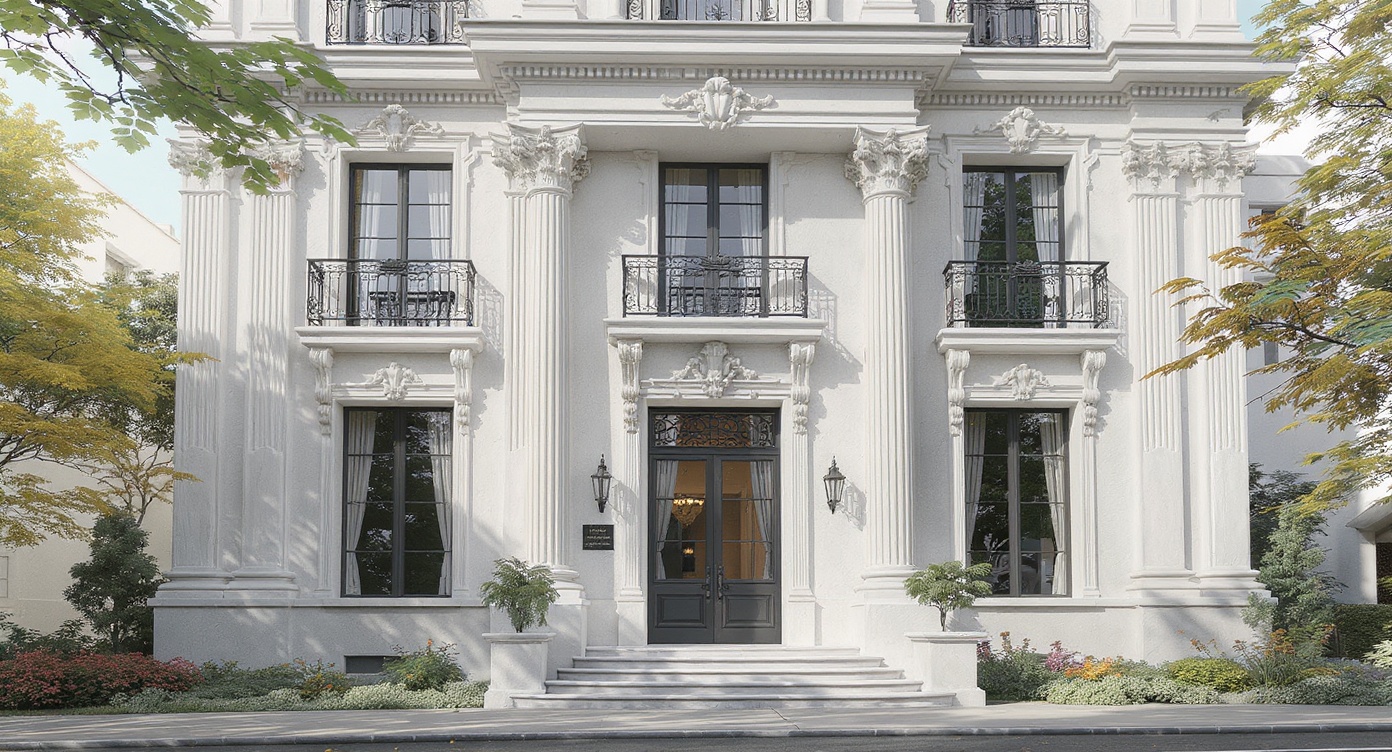
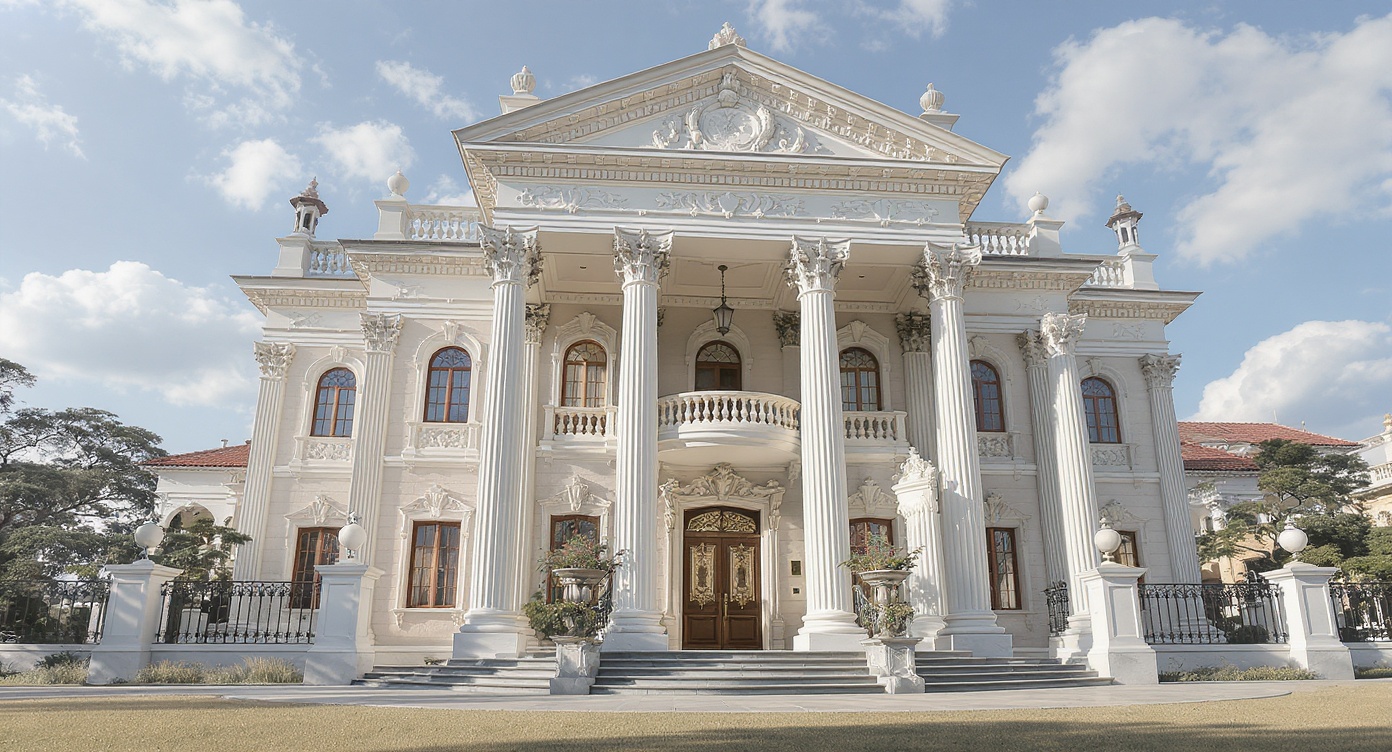
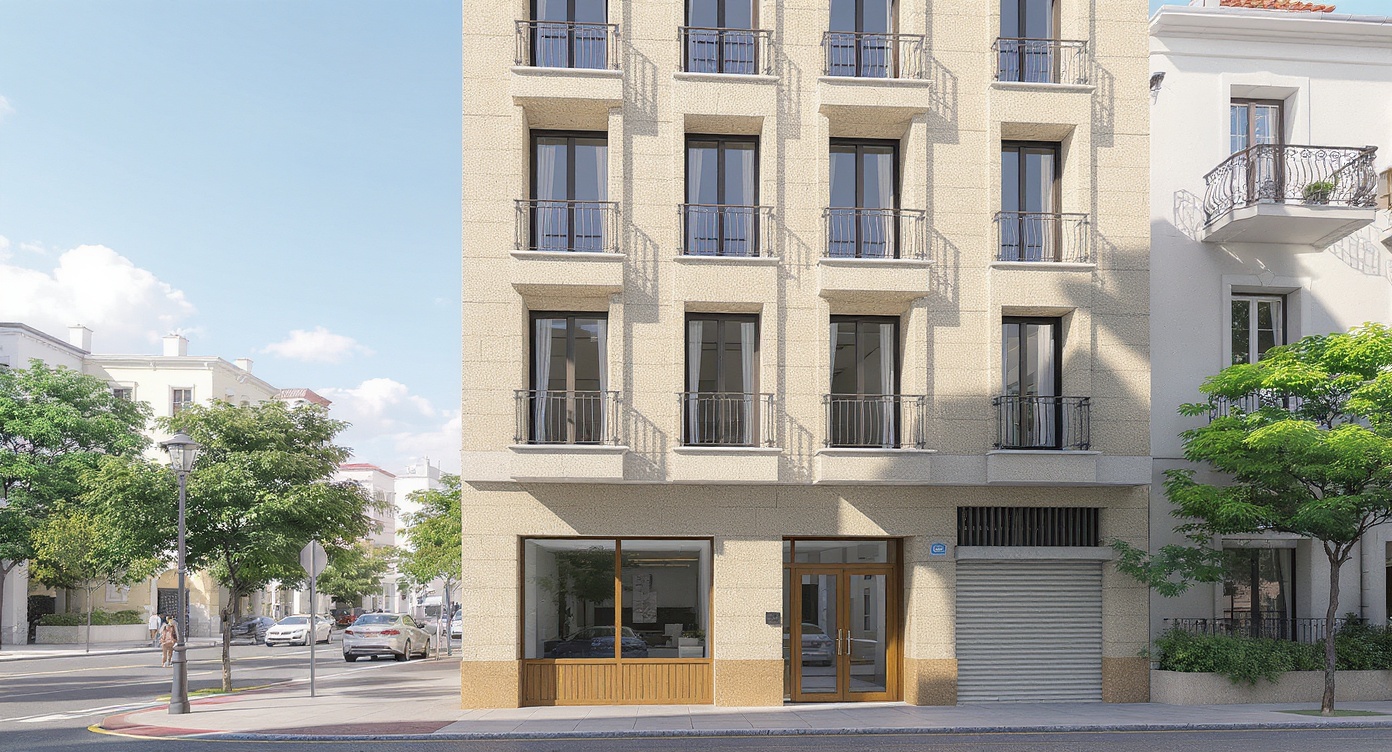
The façade presents a disciplined neoclassical composition that balances monumental order with domestic scale. Vertical rhythm is established by four fluted pilasters with enriched capitals that read as a contemporary interpretation of Corinthian ordering; their deep fluting casts fine linear shadows at noon, reinforcing verticality against the broad planar stucco. White stucco is specified with a subtly varied micro‑texture rather than a perfectly smooth plaster finish, allowing specular highlights on the light-facing planes and delicate tonal gradation where midday shadows wrap into the mouldings. Carved cornices and entablature use a slightly denser profile in material definition so that occlusion around beadings and dentils reads crisply without appearing over‑sharpened.
Black ornamental metalwork—balcony railings and entry gates—functions as a counterpoint to the whiteness of the envelope. The wrought‑iron finishes are tuned to a low‑gloss, near‑matte black with faintly reflective edges so cast shadows remain legible while subtle highlights articulate the scrollwork. Marble entry steps employ a cool, veined statuario-like stone with honed faces; edges catch the sun to emphasize step nosing while tread surfaces show faint, directional micro-roughness for believable wear. Dark-framed sliding glass doors and tall windows use a deep graphite anodized finish; their broad mullions provide a strong vertical grid that recedes visually due to low reflectance and the soft translucency of sheer curtains behind them.
Lighting at true noon is the primary design instrument. With all artificial fixtures off, crisp hard shadows define the cornices and balcony undersides; shallow shadow crevices beneath window sills and beneath the capitals create legibility and depth. The sunlight angle is nearly zenithal but slightly inclined to produce diagonal shadow castings from the iron railings onto the stucco, which animates otherwise planar surfaces. Sheer curtains diffuse interior glare, producing warm, muted backlight that contrasts with the cool exterior daylight and signals inhabited domesticity without compromising external photorealism. Planting and positioned people in the backplate are preserved intact; tree canopy edges filter light and throw dappled shade on the façade periphery, providing a biophilic tempering to the formal composition.
Structurally, the façade reads as load-bearing masonry with articulated vertical piers and horizontal entablature that visually carry weight. The carved elements and cornices are modeled with measured radii and realistic undercuts to catch specular highlights and form shadow crispness. Ambient occlusion is applied sparingly at junctions—mullion meets jamb, cornice returns, baluster bases—so the overall image retains photoreal subtlety rather than an over‑contrasted look. The resulting mood is restrained and authoritative: midday clarity that emphasizes craft and material honesty while preserving a quiet residential warmth through controlled contrasts and natural planting.