


About this Design
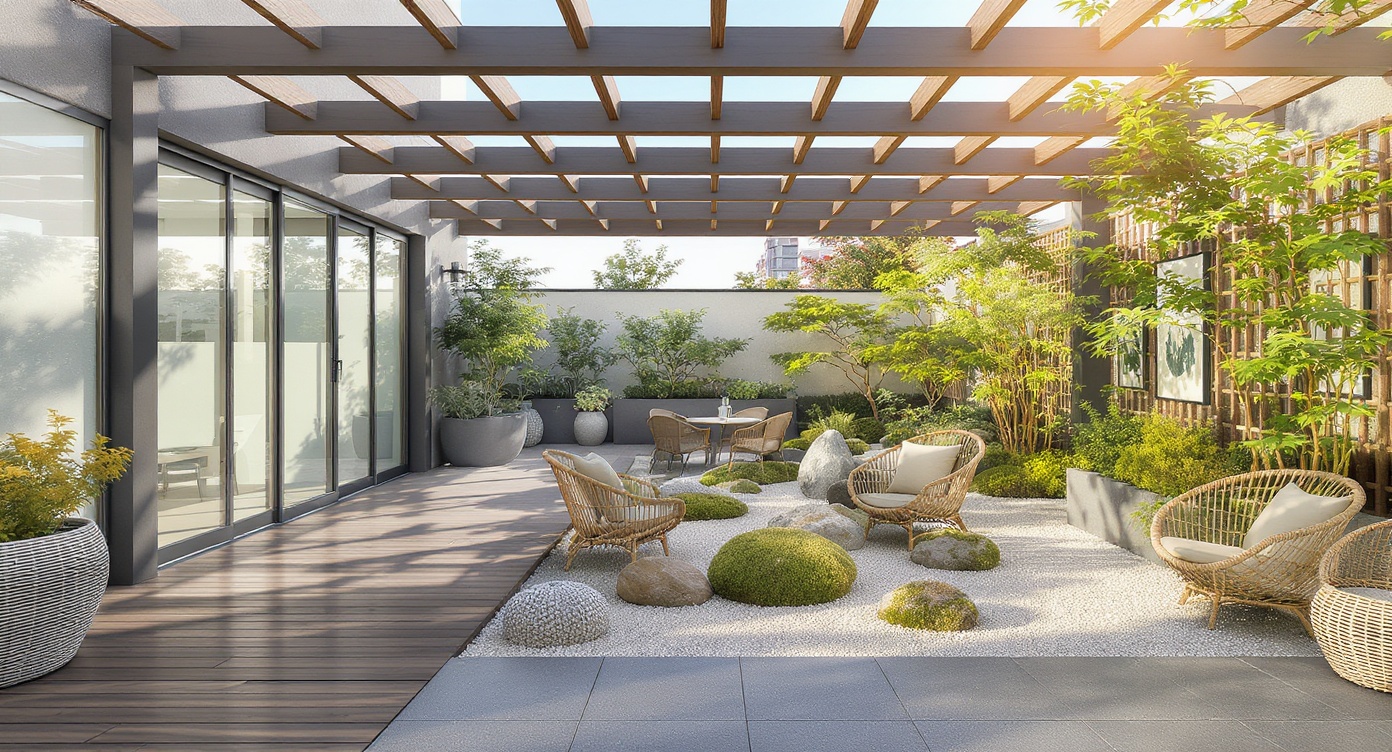
This composition resolves a restrained material palette into a layered, tactile rooftop setting. The pergola — a lattice of painted timber beams with inset glass panels — frames the terrace while admitting warm, directional morning sunlight. The light reads differently across surfaces: the polished dark-wood decking on the left absorbs and reflects in long, amber highlights along its grain, while the large dark-gray porcelain tiles beyond present a low-gloss, slightly variegated plane that grounds the scene and provides a sober counterpoint to the lighter zen bed.
At the center, the white-gravel zen garden functions as both focal point and organizing device. Small, naturally weathered boulders and sculptural moss clumps sit in deliberate clusters; the gravel’s micro-roughness catches scattered light and casts soft, diffuse shadows beneath the moss mounds, emphasizing their volume. Material honesty is maintained — the rocks show mineral pitting and subtle chromatic variation; moss surfaces exhibit subsurface scattering and a deeper saturation where shadow meets texture.
Planting and vertical screens articulate the right side. Tall bamboo in tapered planters and trellis screens create a layered green backdrop that filters sunlight and provides dappled shade. The trellis holds framed art, its matte frames and protected surfaces chosen to avoid specular distraction while contributing to a domestic gallery feeling. Furnishings — woven rattan armchairs and a solid, polished wooden table — are arranged informally to encourage lingering. The rattan weave is rendered with precise shadowing between strands and a slight sheen on edge filaments; the table’s dark wood shows tight grain, slight beveling, and lacquered reflections where light strikes. Glass elements — the pergola panels and large sliding doors — exhibit accurate specular highlights and faint reflections of the surrounding sky and greenery.
Lighting is strictly natural: a clear morning sun casts warm, oblique rays producing long, soft shadows from the pergola beams and plants, defining depth without harsh contrast. Artificial fixtures — lanterns and ambient lamps — remain physically present but unlit, their materiality and placement respected so they read as part of the terrace’s choreography. Spatially, the terrace balances openness with enclosure: the covered left walkway and the open central zen bed create a sequence of experiences that guide movement and sightlines, while the combination of hard surfaces, textured planting, and soft seating produces a calm, contemplative mood with a precise, tactile realism.