


About this Design
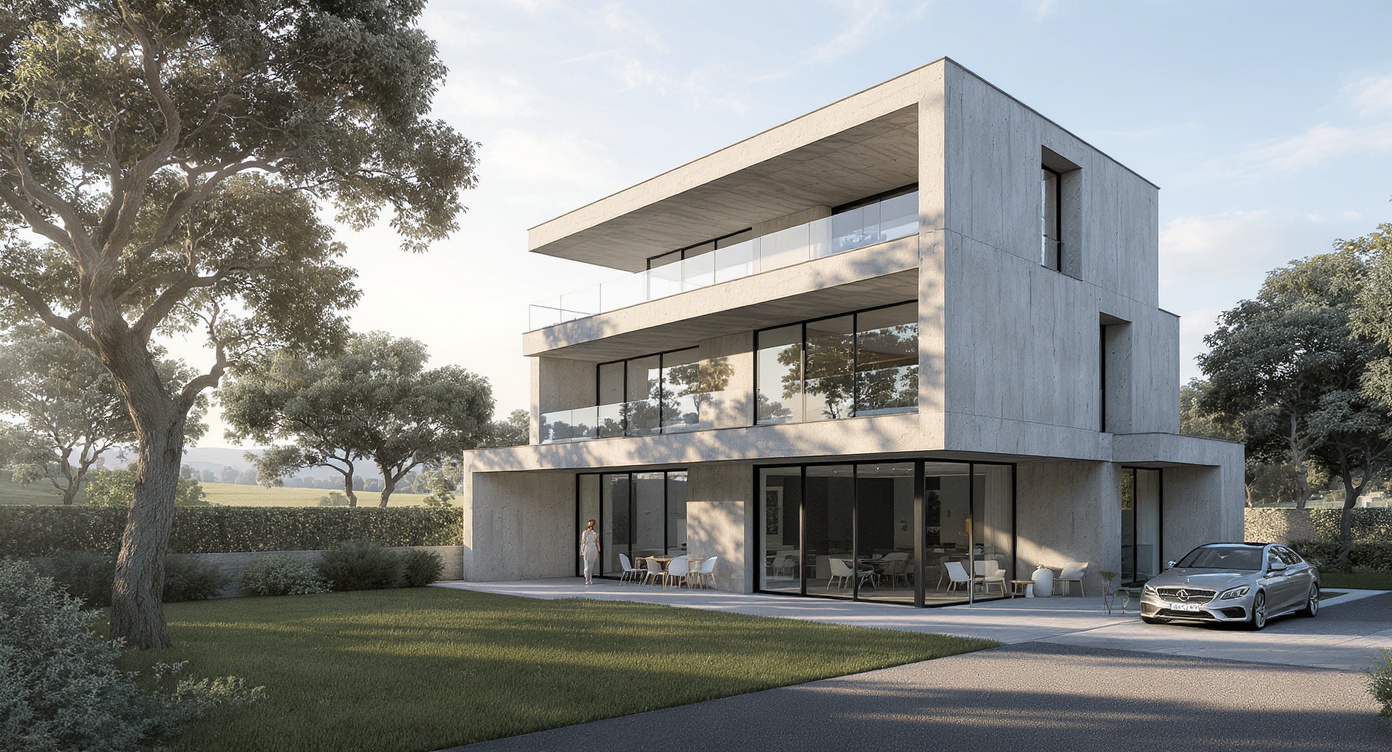
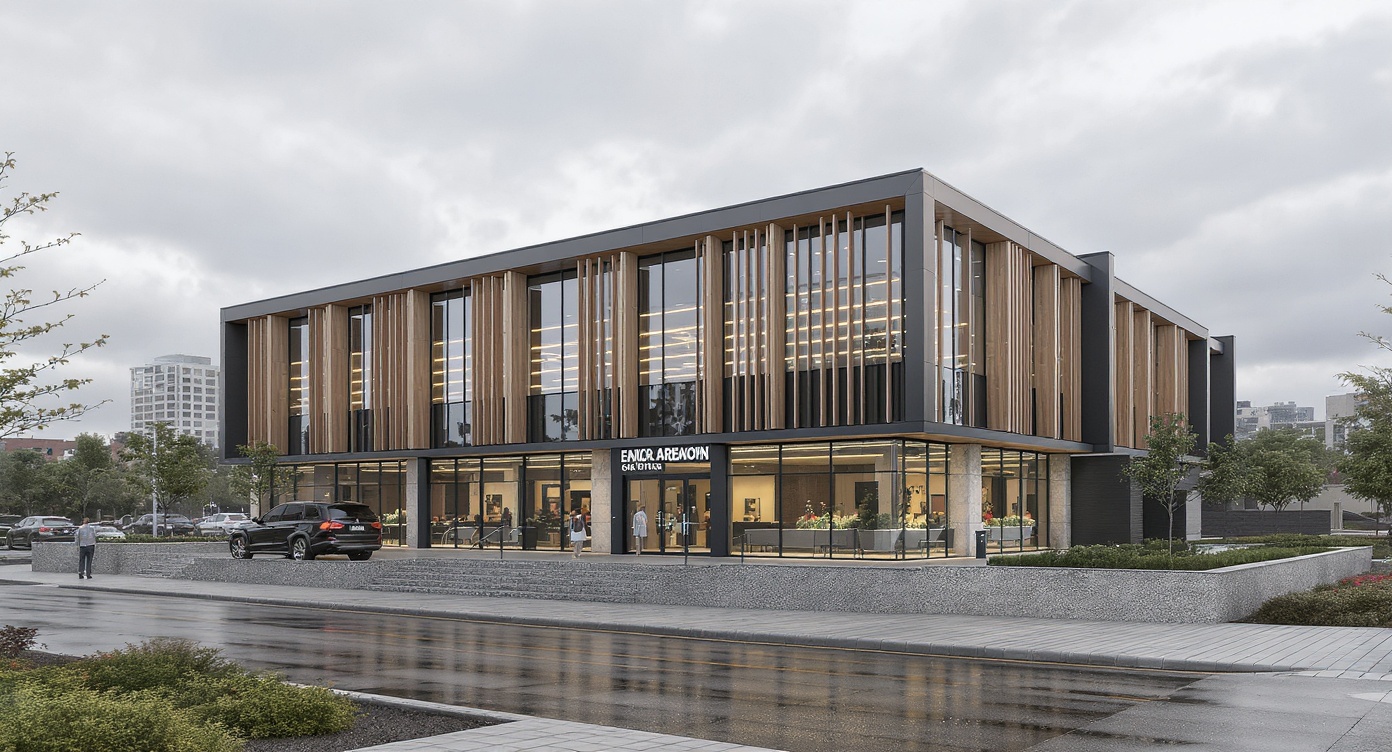
This photoreal exterior emphasizes material honesty and a restrained geometric composition. The building’s three stacked volumes read as cast concrete slabs with subtle board-formed veining and hairline joints that register the casting sequence. Horizontal cantilevers at the second and third floors create sheltered terraces and deep reveals; these overhangs frame long glazing runs and produce a layered silhouette that casts long, crisp shadows across the façade in the low-angle morning light.
Glass is specified as a slightly reflective blue-tinted unit, thin in profile to maintain a minimal mullion rhythm. Reflections are controlled to avoid mirror-like distraction: distant fields and tree lines register softly on the surface while specular highlights catch the sun at acute angles, producing thin bright ribbons along the window edges. Where glazing meets concrete, contact shadows are deliberately strong — a soft ambient occlusion develops in the curtainwall junctions and balcony undersides, lending weight to the cantilevers and clarifying depth relationships.
The ground plane composition balances paved surfaces and a modest lawn. The driveway uses a fine-textured paving with worn aggregate, creating micro-variation in specular response and realistic contact shadows beneath the parked car and at the curb. The patio juxtaposes smooth concrete slab flooring against natural grass; the outdoor dining set sits on the lawn, its cast shadows elongated by the morning sun and anchored by crisp occlusion at leg-floor intersections.
Vegetation is calibrated for scale and atmosphere: a few mature trees with articulated trunks and dappled canopies punctuate the lot, their shadows filtering across façade planes and glazing to animate surfaces. Small shrubs and hedges provide a low green belt that separates the property from the rural backplate. The backplate itself — distant fields and gentle tree lines — is slightly desaturated to suggest atmospheric perspective and to keep the primary focus on the house.
Lighting is exclusively natural. The sun’s low angle sculpts texture in the board-formed concrete, accentuating veining and casting slender highlights on metal flashings and glass edges. All artificial fixtures remain off, ensuring the scene reads purely from daylight: soft ambient fill in shadowed recesses, crisp highlights on exposed horizontal edges, and believable contact shadows where building meets ground. A single human figure at the entrance gives scale and narrative, while the composition’s restrained palette and measured detailing evoke a calm, rural modernism rooted in material clarity and daylight modulation.