


About this Design
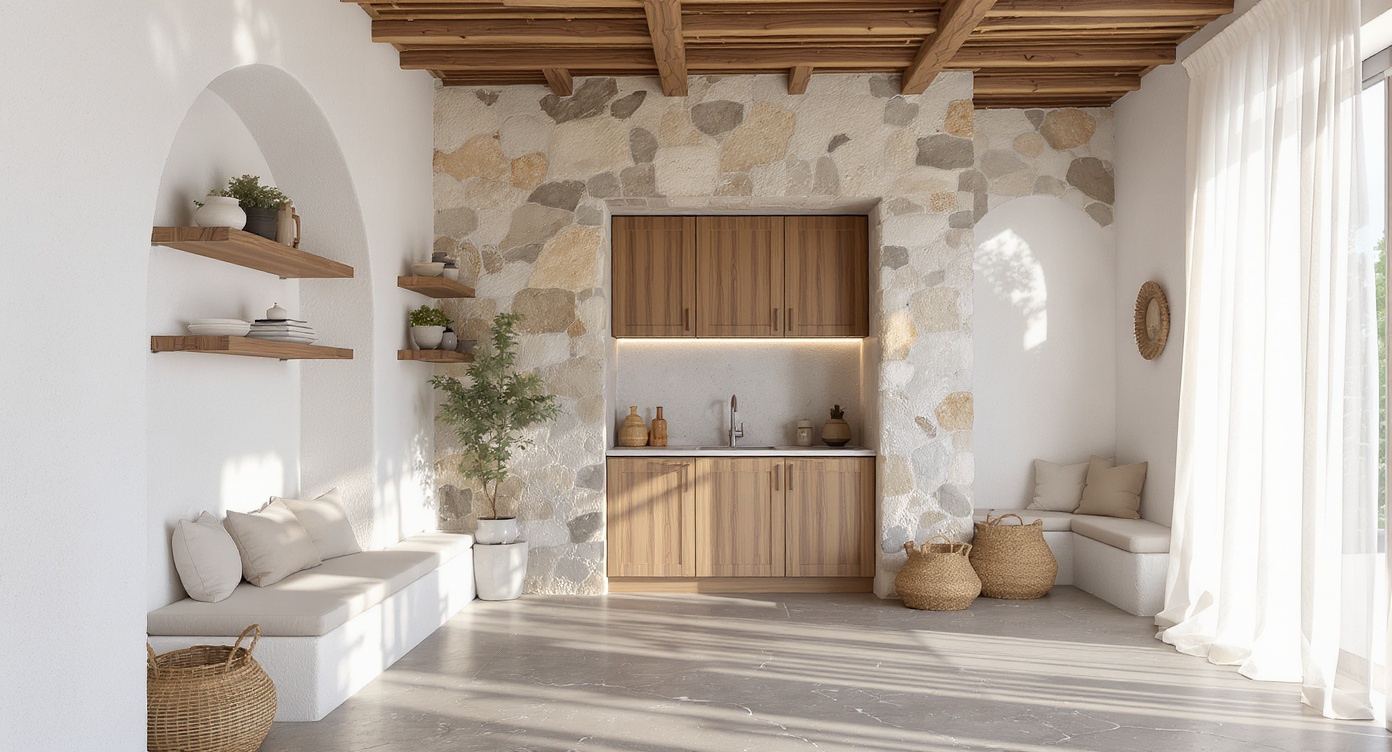
This render articulates a restrained Mediterranean idiom through material honesty and measured proportion. The composition is anchored by a rough, irregular light-grey stone column that reads as a tectonic fulcrum between the compact kitchenette and the built-in bench seating. The stone’s varied massing—subtle beige and grey veining, pitted mortar joints—creates a counterpoint to the pared-back white plaster bench and walls, whose rough trowel marks remain visible at close range. Those tactile plaster surfaces are integral to the scheme: they catch low-angle morning light and translate it into soft, diffuse highlights rather than specular glare, reinforcing the room’s calm register.
Spatially, the benches along both sides establish a symmetrical, intimate niche that frames the kitchenette. Arched wall niches and floating wooden shelves are recessed just enough to create shadowed reveal lines, allowing ceramics and candles to sit within pockets of softer shadow. The recessed wooden cabinet doors of the kitchenette mirror the medium-tone wood of the shelves and the small round stool, tying the composition together through consistent grain and tone. Cabinet insets are flush and minimal—handles are discreet, preserving the quiet plane—while the countertop and sink remain low-key, allowing the surrounding textures to dominate the sensory reading.
Lighting is carefully considered: ambient ceiling fixtures provide a gentle interior fill that complements daylight rather than competing with it. Morning sun filters through sheer curtains on the right, producing long, soft shafts and delicate shadow patterns across the poured concrete floor. The floor finish is not perfectly uniform; subtle imperfections and micro-variations in sheen and aggregate exposure register realistically under the angled light, communicating materiality underfoot. Wood-lattice ceiling beams cast narrow linear shadows that articulate the vertical dimension and produce a rhythmic sequence above the stone column and kitchenette. Decorative choices—minimal cushions with linen-like fabrics, a few candles, ceramics, and woven baskets—are intentionally sparse, allowing texture and light to set the mood: a serene, tactile morning atmosphere where material contrasts (plaster’s matte grain, wood’s warm striations, stone’s irregular mass, and concrete’s nuanced patina) define the space’s character.